KROGER - BUILDING A UNIFIED CUSTOMER DATA PLATFORM FOR PERSONALIZATION & AI AT SCALE
BACKGROUND:
Kroger operates one of the largest grocery ecosystems in the U.S., serving 135+ million customers across 20+ banner brands, including Fred Meyer, Smith’s, Harris Teeter, Mariano’s, King Soopers, and Fry’s.
Each banner—and each business domain within Kroger—captured different aspects of the customer relationship. Customer data existed across multiple systems, including:
Ecommerce and in-store purchase history
Loyalty program data
Pharmacy records
Fuel and convenience transactions
Digital engagement across web and app experiences
While this data was rich, it was also highly fragmented—spread across systems, teams, and business units.
At this scale, even small inconsistencies in customer data could have an outsized impact on personalization accuracy, customer experience, and downstream analytics. At the same time, Kroger was evolving toward more advanced, data-driven experiences—requiring a more unified and scalable approach to customer data.
This complexity created both an opportunity and a challenge: unlocking the full value of customer data required rethinking how it was structured, governed, and activated across the enterprise.
PROBLEM:
Because customer data was fragmented and inconsistently structured, Kroger lacked a reliable foundation for personalization and predictive systems.
There was no clear distinction between:
Explicit data — information directly provided by customers (e.g., name, address, preferences)
Implicit data — behavioral signals inferred from actions (e.g., purchase patterns, product affinity)
As a result:
Personalization efforts were inconsistent across channels
Customer signals were often noisy or conflicting
Teams lacked a shared, trusted view of the customer
Machine learning models were limited by unreliable or poorly structured inputs
BEFORE: FRAGMENTED DATA & LIMITED PERSONALIZATION
Despite high loyalty engagement, customer data was incomplete, limiting personalization and strategic decision-making.
GOAL:
Our goal was to create a unified, privacy-compliant customer data foundation that could:
Consolidate customer signals across all touchpoints
Clearly define and separate explicit vs. implicit data
Enable consistent personalization across channels
Provide a reliable input layer for AI/ML systemsSOLUTION:
We designed and began implementing a centralized customer data platform that unified signals across Kroger’s ecosystem into a single, governed foundation.
At its core, the system created a Single Customer View, aggregating data across ecommerce, in-store, pharmacy, fuel, and loyalty systems.
A key innovation was the introduction of a signal classification framework, separating:
Explicit Data: Directly provided by customers
Implicit Data: Behavioral and inferred signals generated through interactions
This distinction improved how data could be interpreted, trusted, and used across systems.
The platform also included a privacy and compliance layer, enabling:
State-specific data handling rules
Governance over how different types of data could be activated
By centralizing and structuring customer data in this way, we created a scalable foundation that could be leveraged across multiple teams and use cases.
MY ROLE:
As Product Manager for Loyalty & Customer Data, I led the product definition and cross-functional alignment for this initiative.
Defined the product vision and roadmap for a centralized customer data platform
Partnered with:
Data Science to align on model input requirements and signal quality
Engineering to design scalable data pipelines and system architecture
Legal & Privacy teams to ensure compliance with state-specific data regulations
Established foundational frameworks for:
Explicit vs. implicit data classification
Data quality standards and governance
How customer data could be accessed and used across teams
SOLUTION:
We designed and began implementing a centralized customer data platform that unified signals across Kroger’s ecosystem into a single, governed foundation.
At its core, the system created a Single Customer View, aggregating data across ecommerce, in-store, pharmacy, fuel, and loyalty systems.
A key innovation was the introduction of a signal classification framework, separating:
Explicit Data: Directly provided by customers
Implicit Data: Behavioral and inferred signals generated through interactions
This distinction improved how data could be interpreted, trusted, and used across systems.
The platform also included a privacy and compliance layer, enabling:
State-specific data handling rules
Governance over how different types of data could be activated
By centralizing and structuring customer data in this way, we created a scalable foundation that could be leveraged across multiple teams and use cases.
HOW KROGER UNIFIED CUSTOMER DATA FOR PERSONALIZATION
To solve this, we built a system that could unify fragmented customer records into a single, reliable profile. This system standardized, matched, and merged customer records into a unified profile that could power personalization and analytics.
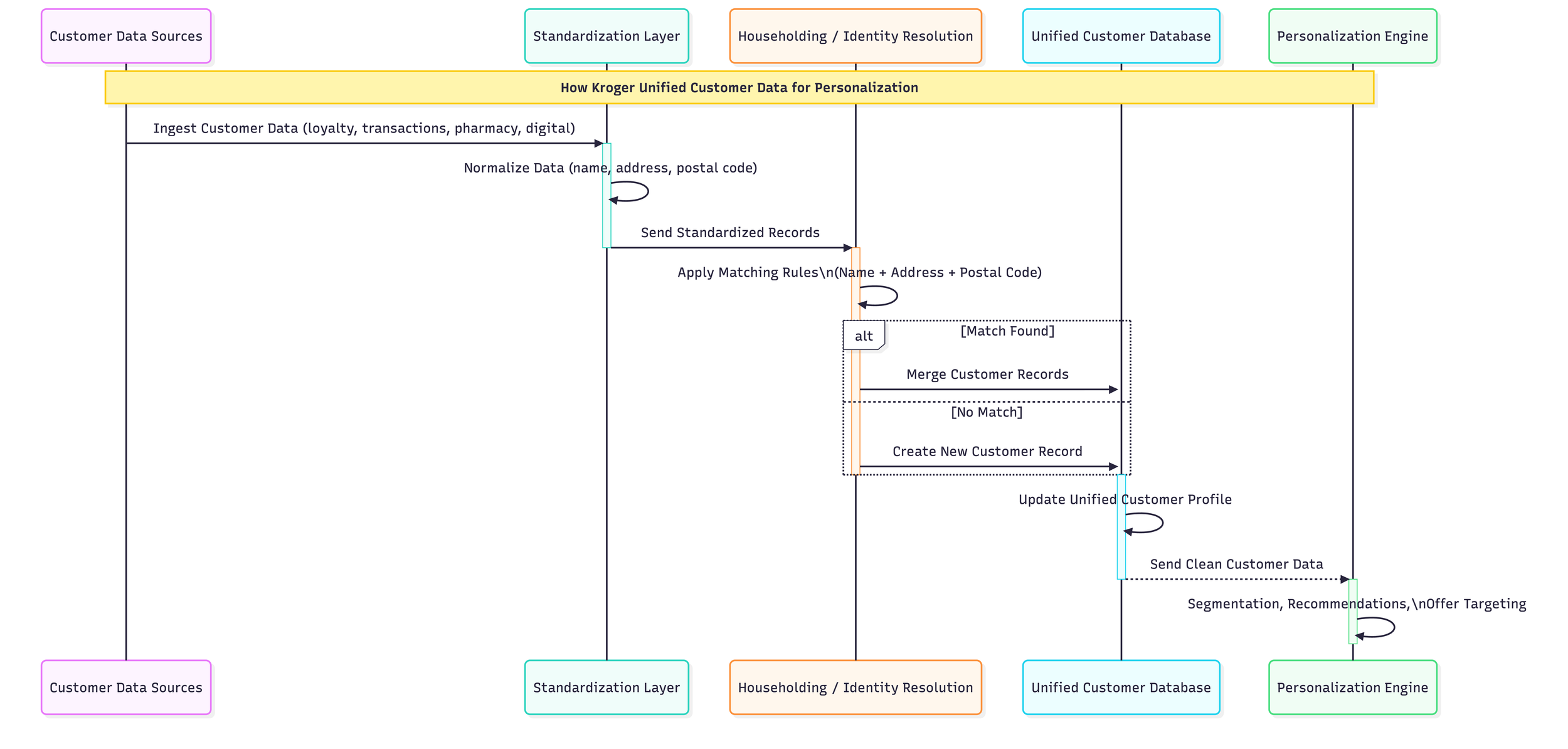
While this system significantly improved data quality, it still relied on inferred relationships—leaving room for a more customer-controlled approach.
ENABLING AI & PERSONALIZATION:
This system became the foundation for downstream AI and machine learning applications.
By improving the structure and quality of customer signals, we enabled:
More accurate customer segmentation models
Improved product recommendations and offer targeting
Better alignment between stated preferences and observed behavior
Separating explicit and implicit data reduced noise in model inputs and increased confidence in inferred attributes—resulting in more reliable and effective personalization systems.
CUSTOMER IMPACT:
This unified data foundation directly powered more relevant and personalized customer experiences across Kroger’s ecosystem.
Examples included:
Behavior-based segmentation, such as identifying “Saver,” “Explorer,” or “Routine Shopper” profiles
Personalized digital coupons and promotions, aligned with customer preferences and behaviors
Product recommendations, highlighting frequently purchased or highly relevant items
These experiences were made possible by a more accurate and complete understanding of each customer—combining what they told us with what their behavior revealed.
KEY TRADEOFFS:
Designing this system required balancing several competing priorities:
Personalization vs. Privacy
Delivering relevant experiences while respecting customer data rightsData Completeness vs. Compliance
Ensuring data could be used appropriately across varying state regulationsCentralization vs. Flexibility
Creating a single source of truth while supporting diverse team needsSpeed vs. Data Quality
Prioritizing accuracy and trust over rapid ingestion when necessary
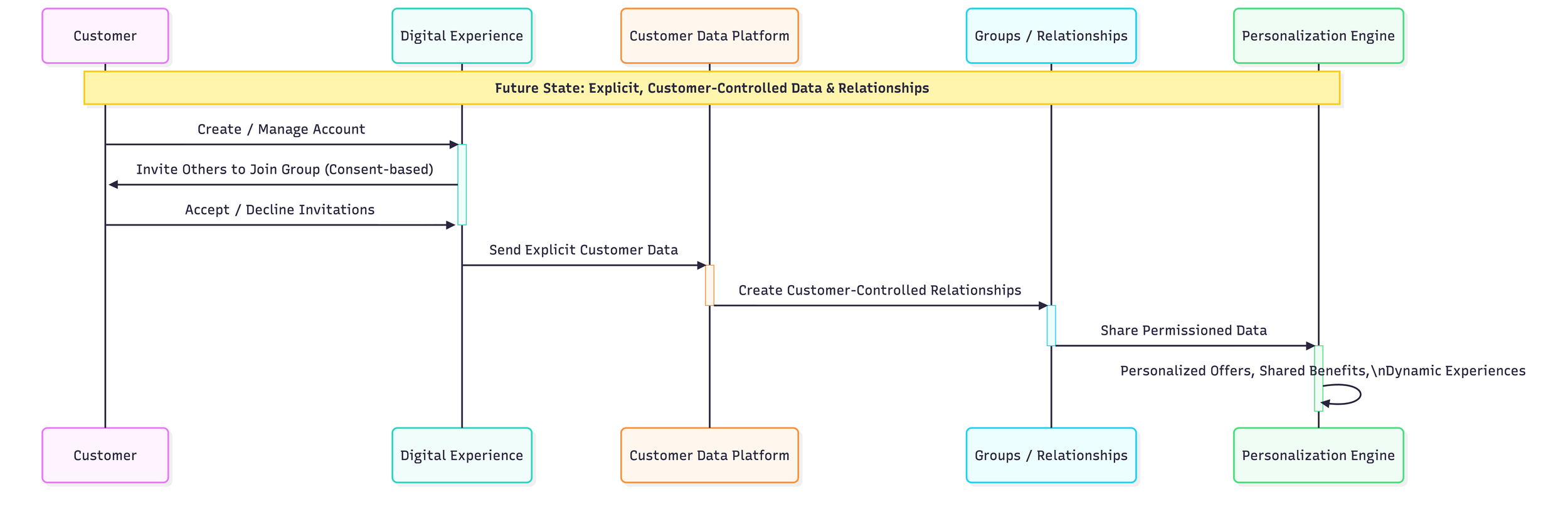
FUTURE STATE: CUSTOMER-CONTROLLED DATA & RELATIONSHIPS
The next evolution is shifting from inferred relationships to explicit, customer-defined connections. Customers explicitly define relationships and permissions, improving trust, accuracy, and personalization outcomes.
IMPACT:
As a foundational platform, this work unlocked improvements across the business:
Increased effectiveness of targeted offers and promotions
Improved alignment between customer preferences and recommendations
Enabled scalable personalization across multiple business units
Reduced inconsistencies in customer data used by downstream teams
WHAT I’D DO WITH AI TODAY:
With today’s advancements in AI, I would extend this system further by:
Enabling real-time, dynamic segmentation using streaming behavioral data
Using LLMs to interpret complex customer patterns beyond predefined segments
Applying reinforcement learning to continuously optimize offer targeting
Improving explainability of inferred attributes to increase customer trust
Introducing conversational personalization, allowing customers to directly interact with and refine their preferences
KEY TAKEAWAY:
This work was not just about consolidating data—it was about creating the foundation for intelligent, personalized customer experiences at scale.
By structuring and governing customer signals thoughtfully, we enabled systems that could better understand, predict, and serve millions of customers—while balancing personalization with trust.